Take To Fun Translator

Friday, 12 April 2013

Sprint Pushing Android Update to Samsung Galaxy Victory


The Samsung Galaxy Victory, Virgin Mobile's first LTE-enabled smartphone, is being updated to Android 4.1.2.

Sprint has begun rolling out an Android update to users of the Samsung Galaxy Victory—the first Long Term Evolution (LTE) enabled phone on the Virgin Mobile network.
Virgin Mobile began selling the Victory Feb. 25, with Android 4.1, a flavor of "Jelly Bean," on board. Sprint's April 11 news of an update is to Android 4.1.2—a subtle boost up, but one that nonetheless brings with it:
—Swype, a method of typing that lets a user drag her finger or a stylus around in one single gesture, instead of lifting and tapping at letters or numbers;
—notifications now display the full text of incoming SMS messages, and recipients of MMS messages can see the whole photo in the notification;

Sara Bharwana: Meet With Atif Aslam’s Gorgeous Wife


Oh girls, are you are really heart broken today, same like me? Finally, she is the luckiest girl who remained successful to win the heart of the guy who lives in millions of hearts of girls here in Pakistan, India and Bangladesh.


Oh girls, are you are really heart broken today, same like me? Finally, she is the luckiest girl who remained successful to win the heart of the guy who lives in millions of hearts of girls here in Pakistan, India and Bangladesh.


Yes, you are thinking right, I am talking about the gorgeous Sara Bharwana who is now officially bride of Asia’s biggest music star Atif Aslam. Atif Aslam and Sara Bharwana mehendi ceremony was held on 26th of March 2013. Atif and Sara have known each other over seven years.


Atif Aslam wrote on his Facebook account to 4.8 million fans, “Dear Aadeez, U guys have always been a part of my family and have stood by me through my incredible highs and not so incredible lows. I am delighted to let all of you know that…… Har insan ka zindagi main aik na aik din WIYAAAH hona hota hayyy ,,, and my Big day has finally arrived with your prayers.”

He continued, “ALLAH has endowed me with a wonderful life partner. I would request all of you to continue praying for us as you have always being doing in the past for me. Mehndi , barat n walima pictures are on their way.”


Their Valima reception will be held on March 29, 2013 at Royal Palm club, Lahore on Friday. The gorgeous bride Sara is looking beautiful and glamorous in the recent mehndi photos. She is educated from Lahore’s Kinnaird College for Women. Ms Sara love teaching as profession.


She was elected president of sports club of the college and was also nominated as the most beautiful girl of college. So, it can be said that “Tera Hone Laga Hun” singer choosed really a beautiful girl to wed.  

Great companies benchmark differently

In a recent post in this benchmarking series, I discussed the issues I see with defining benchmarking peer groups based on industry. That led me to share the similarities I see among great companies when they benchmark.


Benchmarking roles

In our benchmarking projects, there are primarily two roles. The sponsors are the organizations wanting to learn how to improve business processes, and the partners are the organizations selected for their innovative practices. Partners are the organizations sharing their practices with the sponsoring organizations. They are selected because they perform well in the focus area for the benchmarking project.
There are organizations that are regularly recognized as partners in numerous benchmarking projects, as well. They have proven, stellar performance in many process areas, and, theoretically, when they participate in a benchmarking project, they aren’t gaining a lot. They are good after all. They share what they do and the other organizations learn how to improve.
But, when I ask those organizations what they get out of a benchmarking project, they consistently respond in a similar fashion.

What I’ve noticed about the really good companies

These are just a few of the things I’ve noticed about how really good organizations approach benchmarking.
  • They never think we are good enough and never stop learning. They always want to improve, and they are relentless about it.Improve
  • They feel we can learn something from anybody, and seldom focus on industry peers. They’ve gotten past that hang-up and understand they have to think about things differently than their industry peers. They are always trying to shed those industry filters that influence the way industry peers think and operate.
  • They don’t want to be as good as their industry peers, they want to eclipse them. They are looking for breakthrough performance, not incremental increases, and they see industry designation as just a matter of chance. They have industry peers due to the fact they are in a similar market serving similar customers or providing similar products and services. That is the sum of it; they don’t see this industry peer filter. Industry peers are just like any other organization. If they can learn from industry peers, great, but that criteria isn’t anywhere near the top of their priority list.
  • They have a very sound way of taking the things they learn from benchmarking and integrating them into their organization. They realize organizations aren’t plug-n-play, so they look for the atomic-level factors that drive performance, and they know how to get them in the hands of the right person. Their process of evaluating the appropriateness of implementing benchmarking findings allows them to focus. They can’t implement everything, and they can effectively determine what to implement and what they need to ignore.
These things seem to be embedded in their DNA, they are interesting, and they are very open in sharing. When they share, they know information flows back to them tenfold. Bottom line; everyone likes working with them.
Do you work there?


How Shipping Software Teaches You to Make Tough Choices


Several years ago, I had a job that seemed like heaven. We were a new team building a new product. We were using new technology: C# 2.0 (yes, people were once excited about major releases of C#). We were using new techniques, like scrum and test-driven development. It was greenfield development in every possible sense, except for the one where our desks would actually be situated in a green field.
I lived in this environment for a few years. I learned a lot about software development, technical leadership, and how to build big systems. Ultimately, though, I think I wasted those years. Why?  We never shipped.
Something magical happens when you ship software: your decisions suddenly have consequences. You suddenly must consider trade-offs. Hopefully, people suddenly care. If they don't, you suddenly must correct that.
What's the big deal about decisions and consequences? Any fool with a text editor can write code, but only an amazing few can code and make good choices around trade-offs. That's the most valuable skill a developer can possess: the ability to make hard decisions. (That's actually a great way to make career choices: opt for the place that'll let you make harder decisions.) Like riding a bike or juggling chainsaws, the only way to get good at making hard decisions is by doing it a lot.  Each time you make one of these decisions, gather data and iterate accordingly.
When I was working on that project that never shipped, I felt like I was making hard decisions. We had big meetings and loud arguments about things that seemed important at the time. You can bet your sweet bippy that we came to conclusions on all sorts of things. However, since we never shipped, we never got any data about any of the choices we made around things like architecture, code coverage, implementation decisions, featureset, and user interface. Without that data, we had no way of knowing if we had chosen correctly. Did we get better at making hard decisions?  Without users, how could you tell?
There was an easy solution to the problem I faced at that job: ship the dang thing. That decision wasn't up to me, so I should've done the next best thing: join a different team, one that shipped a ton of code. Even if the codebase is worse and the product is less interesting, find a role where you ship; it's the only way you get better.

An Overview of JAX-RS 2


JAX-RS 2 is one of the most significant parts of the upcoming Java EE 7 release. In a brief article, consultant, German author and celebrated Java EE advocate Adam Bien does a great job of overviewing the major changes in JAX-RS 2. He talks about asynchronous processing, EJB/CDI integration, filters/interceptors, the configuration API, the client API and more.
If the article whets your appetite to learn more about JAX-RS 2, you could download the actualproposed final draft and give it a read. For those unaware, JAX-RS 2 recently passed its public review ballot. At just above 90 pages, the actual JAX-RS 2 specification document is not that bad of a read.

Thursday, 11 April 2013

Apple Says iMessage and Facetime Services Are Down For Some


The photo above serves as a harsh reminder of the consequences of texting while driving. The unfinished text, never sent, was typed by 22-year-old Alexander Heit as he was driving through a small town in Colorado earlier this month.

Before Heit had a chance to finish typing the text, his car drifted onto the wrong side of the road. Realizing his mistake, he overcorrected, quickly turning the steering wheel in an attempt to move his vehicle back into the right lane. He lost control of the car and it veered off the highway, rolling and flipping until it came to a stop.
Alex didn't survive the accident, dying a short time later in a hospital.
According to Greeley police, "Witnesses stated he seemed to have his head down ... a westbound vehicle slowed and moved over just before Mr. Heit looked up." It was too late.

Police found Hite's iPhone in the wreckage, with the unfinished text displayed as you see here. "Sounds good my man, seeya soon, ill tw," the text reads.
In a statement to Greeley police, Sharon Hite, Alexander's mother, said, "I can't bear the thought of anyone else having to go through something like this." She continued,
“Please, vow to never, NEVER text and drive. In a split second you could ruin your future, injure or kill others, and tear a hole in the heart of everyone who loves you. And in honor of Alex’s memory, please do something kind for a stranger who needs help, as Alex always wished for a world where people were kinder to each other.”
Alexander Heit's life was cut short, leaving behind his classmates at the University of Northern Colorado where he was studying audiology. He was said to be a good student, liked snowboarding and hiking and had a quick sense of humor.
We can all learn something from this. As a parent whose child was in a serious accident because of her texting and driving, I have first-hand experience with this careless act that makes it more dangerous for everyone on our streets and highways.
It's not just young people who are guilty of texting while driving, either. A recent study showed that adults are getting into the act, texting and driving even more than teens.


Apple Says iMessage and Facetime Services Are Down For Some


For about an hour, we’ve been getting reports of Apple’s iMessage system encountering errors and issues including delays and send failures. A couple of minutes ago, Apple acknowledge the issue and noted on its iCloud status site that ‘some users’ may be seeing issues with both iMessage and Facetime.
Apple’s system status panel indicates that the outage began just under an hour ago, and is ongoing at this point.  A twitter search for iMessage results in a new complaint roughly once every second or more, so whatever ‘some’ means, it’s a lot. Apple’s iCloud servicesgrew 31.5% in the last few months to some 250M users with those users sending 2 billion iMessages a day, so even a small percentage of those is going to be a lot of people.


If you’re wondering why we continue to report on the status of iMessage outages, you can check out this piece from back when Apple was facing the first backlash against its Maps issues. Apple, as a service company, has a responsibility to get this right. If it wants iMessage to be a default communications method, it needs to have near 100% uptime. It’s not too bad overall, but there are still regular outages.

Apple’s iMessage Is Down Again (AAPL)


Not that it should come as a surprise to anyone, but Apple‘s iMessage is down right now. 

Several users have reported problems sending iMessages and Apple’s iCloud status page says the service is experiencing issues. 
FaceTime, the video chat feature on iPhones and iPads, is also down.
If you’re trying to send messages to friends, the best thing to do is send them as a regular text message for now. Just press and hold the speech bubble with your text and select “send as SMS.”


FUSION ROCKET COULD HURTLE ASTRONAUTS TO MARS IN 30 DAYS


Scientists from the University of Washington and a private company are working on a fusion-powered rocket that could slash the estimated four-year round trip from Earth to Mars to a maximum of 90 days.

The technology might also make flights to the red planet affordable -- the launch costs alone of such a manned flight using chemical rocket fuel is about US$12 billion, according to UW.
Cutaway Image of Fusion Rocket Design

The project has received two rounds of funding from NASA's Innovative Advanced Concepts Program. It's led by John Slough, an associate professor of aeronautics and astronautics at UW who is also president and director of research at MSNW, the private company working on the project.

 Project Details
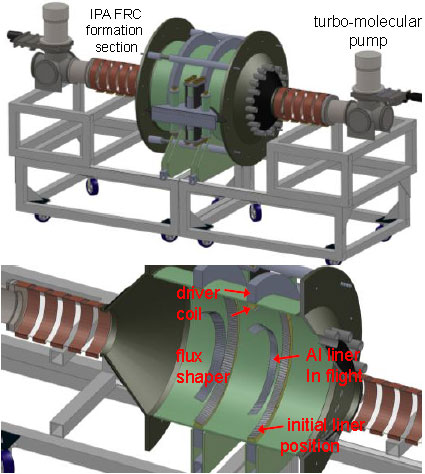
The project uses powerful magnets to implode lithium rings, which collapse a conventional deuterium-tritium mix of fusion plasma into a fusion state about once a minute.
Lithium was used because it is the lightest metal, meaning it has the smallest atomic number, Slough told TechNewsWorld. "For a given fusion energy yield, the lightest atoms result in the highest exhaust velocity -- important if you want to go fast."
One set of three rings weighing about 350 gm will be used for each implosion, Slough said. The pressure inside the rings will reach 600,000 atmospheres for a few microseconds, vaporizing the rings. The resulting superheated ionized metal will be ejected out of a divergent magnetic nozzle at high velocity.

The magnetic field will peak at about 12 tesla, he said. However, it will not affect the spacecraft's onboard computers because "a thin metal sheet is sufficient to screen out a pulsed magnetic field. The field from MRI magnets is of equivalent strength, and it is on steady state in the presence of very sensitive equipment."
Solar energy will be used to charge the capacitors that generate the magnetic power. "Modern capacitors can easily store two kJ (kilojoules) per kilogram," Slough pointed out. "For two MJ (megajoules) of storage, the cap mass is 1 ton. No big deal on a 134-ton spacecraft."
Volume won't be an issue, as the capacitors have roughly the same density as water -- one ton per cubic meter, he added.

"The propulsion aspects aren't necessarily new," Ben Corbin, a Ph.D. candidate in aeronautics and astronautics at the Massachusetts Institute of Technology, told TechNewsWorld.

Getting to Barsoom

The fusion rocket will be activated for roughly 10 percent of the total trip, split between start-up and braking, Slough said. About 200 gm of plasma would be required to fuel a trip to Mars and back.
Roughly 80 metric tons of lithium rings would also be needed, but storage space won't be an issue because "the propellant amounts to less than 50 percent of the spacecraft mass," he said. "Rocket launches from Earth are typically 98 percent propellant."

NASA's Role in Fusion

Slough's team presented its mission analysis for a trip to Mars -- together with detailed computer modeling and initial experiment results -- to NASA in March. All portions of the process have been tested successfully in the lab, and the team now has to combine all the tests into a final experiment that actually produces fusion using its technology.
NASA's two rounds of funding totaled $600,000, Slough said. A NASA spokesperson was not immediately available to comment for this story.
Slough's project isn't NASA's first involvement in fusion. In June 2011, John Chapman, a physicist and electronics engineer at the agency's Langley Research Center in Virginia, presented his idea for a motor that would extract energy from boron fuel instead of the more regularly used deuterium-tritium mix.
Fusion engines are far more efficient than conventional chemical engines. Other approaches to fusion engines include the Variable Specific Impulse Magnetoplasma Rocket (VASIMIR) and the Gasdynamic Mirror Thruster.
Physicists at the University of Alabama in Huntsville are using the Decade Module Two, a pulsed power design used by the U.S. Department of Defense for weapons effects testing in the 1990s. They are trying to fuse lithium and hydrogen atoms and turn some of their mass into pure energy to see whether the theory behind the pulse fusion propulsion model is valid.